# Clusters
Guidance for configuring and operating Materialize clusters.
Clusters provide the compute resources for running dataflows in Materialize.
- Learn about [clusters](/fundamentals/concepts/clusters/).
- Follow the [operational guidelines](/clusters/operational-guidelines/).
- Speed up hydration with [autoscaling](/clusters/autoscaling/).
- Understand [system clusters](/clusters/system-clusters/).
---
## Autoscaling for hydration
> **Public Preview:** This feature is in public preview.
When you create an index, materialized view, or Kafka upsert source, or when a
cluster restarts, the cluster must
[hydrate](/fundamentals/concepts/hydration/) the affected
objects before they can serve results. Hydration reads the input data
and rebuilds in-memory state, and its speed scales with the cluster
[size](/sql/create-cluster/#available-sizes).
The `AUTO SCALING STRATEGY (ON HYDRATION)` option lets a cluster **automatically
provision an extra burst replica at the configured `HYDRATION SIZE` while it has
un-hydrated objects**. This speeds up hydration without manually scaling the
cluster up before hydration and back down afterward. The steady-size replicas
continue hydrating in parallel, and once one of them catches up with the burst,
the burst replica lingers for the `LINGER DURATION` and is then removed. The
burst replica is an ordinary cluster replica, billed only for the time it is
provisioned. See [Usage & billing](/materialize-cloud/billing/) for details.
`AUTO SCALING STRATEGY (ON HYDRATION)` is particularly useful for [blue/green
deployments](/manage/blue-green/), where a new cluster must hydrate before the
cutover. It is only available on **managed clusters**, and cannot be combined
with a cluster `SCHEDULE` other than the default `MANUAL`.
For example, the following cluster can provision a burst replica of size `800cc`:
```mzsql
CREATE CLUSTER fast_start (
SIZE = '100cc',
AUTO SCALING STRATEGY = (
ON HYDRATION (
HYDRATION SIZE = '800cc',
LINGER DURATION = '15s'
)
)
);
```
You can specify the following options:
Option | Description
-------|------------
`HYDRATION SIZE` | The [size](/sql/create-cluster/#available-sizes) of the burst replica provisioned while the cluster has un-hydrated objects. Must differ from the cluster's steady `SIZE`. Choose a larger size to speed up hydration.
`LINGER DURATION` | Optional. How long the burst replica lingers after a steady-size replica catches up, before it is removed. Default: `0s`.
Provisioning the burst replica requires enough compute capacity to run it. In
Materialize Self-Managed, this means your Kubernetes cluster must have enough
spare resources (for example, available nodes) to schedule the burst replica.
The burst is best-effort and never blocks the cluster: if the burst replica
cannot be provisioned, the steady-size replicas still come up and hydrate as
usual, as long as there are enough resources for them.
To remove the autoscaling strategy from a cluster, use `ALTER CLUSTER ... RESET
(AUTO SCALING STRATEGY)` or set an empty strategy with `AUTO SCALING STRATEGY =
()`.
You can inspect the configured strategy and any in-flight burst in the
[`mz_internal.mz_cluster_auto_scaling_strategies`](/sql/system-catalog/mz_internal/#mz_cluster_auto_scaling_strategies)
catalog view.
## Configure autoscaling on an existing cluster
You can also add, change, or remove the strategy after the cluster already
exists:
```mzsql
ALTER CLUSTER fast_start SET (
AUTO SCALING STRATEGY = (
ON HYDRATION (HYDRATION SIZE = '800cc', LINGER DURATION = '15s')
)
);
```
```mzsql
ALTER CLUSTER fast_start RESET (AUTO SCALING STRATEGY);
```
For the full option reference, see the `AUTO SCALING STRATEGY` option on
[`CREATE CLUSTER`](/sql/create-cluster/#autoscaling) and
[`ALTER CLUSTER`](/sql/alter-cluster/#speed-up-hydration-by-autoscaling-to-a-larger-size).
## Monitor an autoscaling event
To check whether a burst is currently running and what it's configured to do,
query
[`mz_internal.mz_cluster_auto_scaling_strategies`](/sql/system-catalog/mz_internal/#mz_cluster_auto_scaling_strategies):
```mzsql
SELECT
c.name AS cluster,
s.strategy->'on_hydration'->>'hydration_size' AS hydration_size,
s.state->'burst'->>'burst_size' AS inflight_burst_size
FROM mz_internal.mz_cluster_auto_scaling_strategies AS s
JOIN mz_clusters AS c ON c.id = s.cluster_id;
```
`inflight_burst_size` is `NULL` when no burst is running, and reports the burst
replica's size while one is up. [`SHOW CLUSTERS`](/sql/show-clusters/) also
summarizes an in-flight burst in its `activity` column, and lists the burst
replica itself, at its larger size, in `replicas`:
```nofmt
name | replicas | activity
-------------+------------------------+-----------------------------
fast_start | r1 (100cc), r2 (800cc) | hydration burst at 800cc
```
To check whether the objects driving the burst have finished hydrating on the
steady-size replicas, query
[`mz_internal.mz_hydration_statuses`](/sql/system-catalog/mz_internal/#mz_hydration_statuses)
for the cluster's steady-size replica IDs. Once every object is hydrated on a
steady-size replica, the burst replica lingers for the configured `LINGER
DURATION` and is then removed.
The [audit log](/sql/system-catalog/mz_catalog/#mz_audit_events) records when a
burst replica is created and dropped, so you can look back at past autoscaling
events after the fact.
## If the steady-size replica never hydrates
The burst replica has no maximum lifetime: if a steady-size replica never
catches up (for example, it's undersized and runs out of memory during
hydration), the burst replica keeps serving indefinitely at the configured
`HYDRATION SIZE`, billed for as long as it runs. This is deliberate: the burst
replica may be the only thing keeping the cluster able to serve results, so
Materialize does not tear it down just because it has been up a while.
If you find yourself in this situation, [resize the cluster](/sql/alter-cluster/#resizing)
to a `SIZE` that can hydrate the objects at steady state. The burst replica
keeps serving throughout the resize, so there's no gap in availability while
you find the right size.
## If capacity is unavailable
Provisioning the burst replica requires enough compute capacity to run it. In
**Materialize Self-Managed**, this means your Kubernetes cluster needs enough
spare resources (for example, available nodes) to schedule the burst replica's
pods. If it doesn't, Materialize keeps retrying automatically; no action is
required on your part, though the burst can't speed up hydration until
capacity frees up.
Either way, the burst is best-effort and never blocks the cluster: the
steady-size replicas come up and hydrate as usual, independently of whether the
burst replica could be provisioned, as long as there are enough resources for
them. If you plan to lean on autoscaling for hydration in a capacity-
constrained Self-Managed deployment, make sure your node pools have enough
spare capacity for the burst replicas you expect to run; see [Resize node
pools](/self-managed-deployments/deployment-guidelines/resize-node-pools/).
## Limitations
- Autoscaling for hydration only speeds up the initial hydration of indexes,
materialized views, and Kafka upsert sources. It does not help with ongoing
freshness or staleness, and it has no effect on
[single-replica sources](/fundamentals/concepts/hydration/#objects-and-hydration)
(PostgreSQL, MySQL, and SQL Server sources), which stay pinned to one replica
regardless of the strategy.
- `AUTO SCALING STRATEGY` cannot be combined with a `SCHEDULE` other than the
default `MANUAL`, and is only available on managed clusters.
- Autoscaling for hydration does not apply to the new generation during a
Materialize Self-Managed version upgrade. Until it's promoted, the new
generation runs read-only and can't provision a burst replica, so it
hydrates only at its configured steady `SIZE`. See [Rollout
strategies](/self-managed-deployments/upgrading/#rollout-strategies).
## Related pages
- [Hydration](/fundamentals/concepts/hydration/)
- [`CREATE CLUSTER`](/sql/create-cluster/#autoscaling)
- [`ALTER CLUSTER`](/sql/alter-cluster/#speed-up-hydration-by-autoscaling-to-a-larger-size)
- [`mz_internal.mz_cluster_auto_scaling_strategies`](/sql/system-catalog/mz_internal/#mz_cluster_auto_scaling_strategies)
- [Blue/green deployments](/developer-tools/dbt/blue-green-deployments/)
---
## M.1 to cc size mapping
The following table provides a general mapping between cc and M.1 cluster sizes:
**cc to M.1:**
| cc Size | M.1 Size |
| --- | --- |
| 25cc | M.1-nano |
| 50cc | M.1-nano |
| 100cc | M.1-micro |
| 200cc | M.1-xsmall |
| 300cc | M.1-small |
| 400cc | M.1-small |
| 600cc | M.1-medium |
| 800cc | M.1-large or M.1-medium |
| 1200cc | M.1-1.5xlarge |
| 1600cc | M.1-2xlarge or M.1-1.5xlarge |
| 3200cc | M.1-8xlarge or M.1-4xlarge or M.1-3xlarge |
| 6400cc | M.1-16xlarge |
| 128C | M.1-32xlarge |
| 256C | M.1-64xlarge |
| 512C | M.1-128xlarge |
**M.1 to cc:**
| M.1 Size | cc Size |
| --- | --- |
| M.1-nano | 25cc |
| M.1-nano | 50cc |
| M.1-micro | 100cc |
| M.1-xsmall | 200cc |
| M.1-small | 300cc or 400cc |
| M.1-medium | 600cc or 800cc |
| M.1-large | 800cc |
| M.1-1.5xlarge | 1200cc or 1600cc |
| M.1-2xlarge | 1600cc |
| M.1-3xlarge | 3200cc |
| M.1-4xlarge | 3200cc |
| M.1-8xlarge | 3200cc |
| M.1-16xlarge | 6400cc |
| M.1-32xlarge | 128C |
| M.1-64xlarge | 256C |
| M.1-128xlarge | 512C |
Some sizes have multiple mappings. When converting between cc and M.1 sizing, we
recommend choosing the larger mapping size first.
---
## Operational guidelines
The following provides some general guidelines for production.
## Clusters
### Production clusters for production workloads only
Use production cluster(s) for production workloads only. That is, avoid using
production cluster(s) to run development workloads or non-production tasks.
### Three-tier architecture
In production, use a three-tier architecture, if feasible.
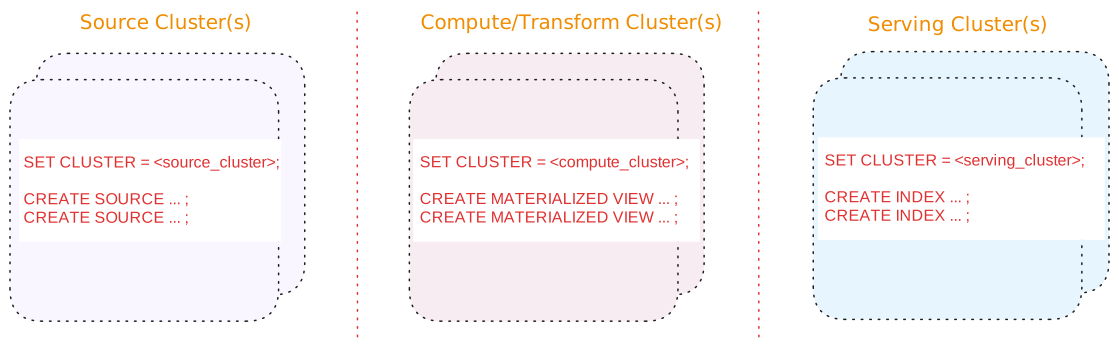
A three-tier architecture consists of:
| Tier | Description |
| --- | --- |
| Source cluster(s) | A dedicated cluster(s) for sources.
In addition, for upsert sources:
-
Consider separating upsert sources from your other sources. Upsert sources have higher resource requirements (since, for upsert sources, Materialize maintains each key and associated last value for the key as well as to perform deduplication). As such, if possible, use a separate source cluster for upsert sources.
-
Consider using a larger cluster size during snapshotting for upsert sources. Once the snapshotting operation is complete, you can downsize the cluster to align with the steady-state ingestion.
|
| Compute/Transform cluster(s) | A dedicated cluster(s) for compute/transformation:
-
Materialized views to persist, in durable storage, the results that will be served. Results of materialized views are available across all clusters.
> **Tip:** If you are using stacked views (i.e., views whose definition depends > on other views) to reduce SQL complexity, generally, only the topmost > view (i.e., the view whose results will be served) should be a > materialized view. The underlying views that do not serve results do not > need to be materialized. -
Indexes, only as needed, to make transformation fast (such as possibly indexes on join keys).
> **Tip:** From the compute/transformation clusters, do not create indexes on the > materialized views for the purposes of serving the view results. > Instead, use the [serving cluster(s)](#tier-serving-clusters) when > creating indexes to serve the results.
|
| Serving cluster(s) | A dedicated cluster(s) for serving queries, including indexes on the materialized views. Indexes are local to the cluster in which they are created. |
Benefits of a three-tier architecture include:
#### Alternatives
If a three-tier architecture is infeasible or unnecessary due to low volume or a
non-production setup, a two cluster or a single cluster architecture may
suffice.
See [Appendix: Alternative cluster
architectures](/clusters/operational-guidelines/appendix-alternative-cluster-architectures/) for details.
## Sources
### Scheduling
If possible, schedule creating new sources during off-peak hours to mitigate
the impact of snapshotting on both the upstream system and the Materialize
cluster.
### Separate cluster(s) for sources
In production, if possible, use a dedicated cluster for
[sources](/fundamentals/concepts/sources/); i.e., avoid putting sources on the same cluster
that hosts compute objects, sinks, and/or serves queries.
In addition, for upsert sources:
- Consider separating upsert sources from your other sources. Upsert sources
have higher resource requirements (since, for upsert sources, Materialize
maintains each key and associated last value for the key as well as to perform
deduplication). As such, if possible, use a separate source cluster for upsert
sources.
- Consider using a larger cluster size during snapshotting for upsert sources.
Once the snapshotting operation is complete, you can downsize the cluster to
align with the steady-state ingestion.
See also [Production cluster architecture](#three-tier-architecture).
## Sinks
### Separate sinks from sources
To allow for [blue/green deployment](/developer-tools/dbt/blue-green-deployments/), avoid
putting sinks on the same cluster that hosts sources .
See also [Cluster architecture](#three-tier-architecture).
## Snapshotting considerations
For upsert sources, snapshotting is a resource-intensive operation that can require a significant amount of CPU and memory.
## Hydration considerations
When sizing a cluster, budget for hydration memory on top of the steady-state
cost. The table below summarizes, per object type, when each object hydrates and
the memory it uses. For more on hydration, including strategies to reduce its
impact, see [Hydration](/fundamentals/concepts/hydration/).
| Object | Hydration behavior |
| --- | --- |
| Materialized views | - **When**: Hydrates on creation and on every replica (re)start or cluster resize. - **What**: Rebuilds the dataflow's operator state: the arrangements that joins, aggregations, and similar operators keep to update results incrementally. Note: A materialized view's result lives in durable storage, so it rebuilds only this maintenance state, not the result. - **Memory Use**: Scales with the view's definition, which it holds at steady state, plus a transient output buffer up to twice the output size: the current output plus a read-back of the previously persisted output. On first creation, since there is no previous output, the buffer is a single output size. |
| Indexes | - **When**: Hydrates on creation and on every replica (re)start or cluster resize. - **What**: Rebuilds the arranged (indexed) data it keeps in memory to serve reads, plus any operator arrangements its dataflow maintains (for joins, aggregations, and similar). - **Memory Use**: Its memory is proportional to the indexed data plus those arrangements, and is held for as long as the index exists. |
| Kafka upsert sources and associated read-only tables/subsources | - **When**: On replica (re)start or cluster resize. These sources do not hydrate on creation; instead, on creation, their indexes are built as part of [snapshotting](/fundamentals/concepts/snapshotting/). - **What**: Rebuilds the table's or subsource's internal upsert index from storage. - **Memory Use**: The index holds the latest value per key, so its memory scales with the source's key space. On standard cluster sizes it can spill to disk when the key space exceeds memory. |
| Append-only Kafka sources and CDC database sources (PostgreSQL, MySQL, SQL Server), and their read-only tables/subsources | - **When**: On replica (re)start or cluster resize, marked hydrated as soon as the dataflow starts. - **What**: Effectively nothing. These sources keep no internal index to rebuild and resume from their persisted position, so hydration is a no-op. - **Memory Use**: Negligible, since there is no index to hold. |
| Webhook sources | Not applicable. A webhook source is not maintained by a dataflow. It receives data pushed over HTTP and writes the data directly to storage, so it does not hydrate. |
| Sinks | - **When**: If created `WITH (SNAPSHOT = true)` (the default), hydrates: - On creation, when the sink first emits its input snapshot. - On a replica (re)start, but only if the sink restarted before recording any progress: it then re-reads the whole input snapshot, and any data already written to the external system is discarded, but the memory cost still occurs. An established sink resumes from its recorded progress without re-reading the snapshot. - **What**: Loads a full copy of its input snapshot into the arrangement that feeds the sink before it can emit. - **Memory Use**: Peaks at roughly a full copy of the input snapshot, then decreases as the snapshot is written out. Negligible on a restart of an established sink. At steady state, a sink retains little in memory. |
| Subscriptions | - **When**: On creation and, while it remains active, on every replica (re)start: the dataflow is re-installed on the (re)started replica and the subscription resumes. A subscription that targets a specific replica instead ends with an error when that replica restarts. A subscription ends with its session and is not reported in `mz_hydration_statuses`. - **What**: Rebuilds the dataflow when it starts. - **Memory Use**: Scales with the dataflow, held while the subscription runs. |
## Role-based access control (RBAC)
**Cloud:**
### Cloud
##### Follow the principle of least privilege
Role-based access control in Materialize should follow the principle of
least privilege. Grant only the minimum access necessary for users and
service accounts to perform their duties.
##### Restrict the assignment of **Organization Admin** role
{{% include-headless "/headless/rbac-cloud/org-admin-recommendation" %}}
##### Restrict the granting of `CREATEROLE` privilege
{{% include-headless "/headless/rbac-cloud/createrole-consideration" %}}
##### Use Reusable Roles for Privilege Assignment
{{% include-headless "/headless/rbac-cloud/use-resusable-roles" %}}
See also [Manage database roles](/security/access-control/manage-roles/).
##### Audit for unused roles and privileges.
{{% include-headless "/headless/rbac-cloud/audit-remove-roles" %}}
See also [Show roles in
system](/security/cloud/access-control/manage-roles/#show-roles-in-system) and [Drop
a role](/security/cloud/access-control/manage-roles/#drop-a-role) for more
information.
**Self-Managed:**
### Self-Managed
##### Follow the principle of least privilege
Role-based access control in Materialize should follow the principle of
least privilege. Grant only the minimum access necessary for users and
service accounts to perform their duties.
##### Restrict the granting of `CREATEROLE` privilege
{{% include-headless "/headless/rbac-sm/createrole-consideration" %}}
##### Use Reusable Roles for Privilege Assignment
{{% include-headless "/headless/rbac-sm/use-resusable-roles" %}}
See also [Manage database roles](/security/self-managed/access-control/manage-roles/).
##### Audit for unused roles and privileges.
{{% include-headless "/headless/rbac-sm/audit-remove-roles" %}}
See also [Show roles in
system](/security/self-managed/access-control/manage-roles/#show-roles-in-system)
and [Drop a
role](/security/self-managed/access-control/manage-roles/#drop-a-role) for
more information.
---
## System clusters
## Overview
When you enable a Materialize region, various [system
clusters](/sql/system-clusters/) are pre-installed to improve the user
experience as well as support system administration tasks.
### `quickstart` cluster
A cluster named `quickstart` with a size of `25cc` and a replication factor of
`1` will be pre-installed in every environment. You can modify or drop this
cluster at any time.
> **Note:** The default value for the `cluster` session parameter is `quickstart`.
> This cluster functions as a default option, pre-created for your convenience.
> It allows you to quickly start running queries without needing to configure a cluster first.
> If the `quickstart` cluster is dropped, you must run [`SET cluster`](/sql/select/#ad-hoc-queries)
> to choose a valid cluster in order to run `SELECT` queries. A _superuser_ (i.e. `Organization Admin`)
> can also run [`ALTER SYSTEM SET cluster`](/sql/alter-system-set) to change the
> default value.
### `mz_catalog_server` system cluster
A system cluster named `mz_catalog_server` will be pre-installed in every
environment. This cluster has several indexes installed to speed up `SHOW`
commands and queries using the system catalog.
To take advantage of these indexes, Materialize will automatically re-route
`SHOW` commands and queries using system catalog objects to the
`mz_catalog_server` system cluster. You can disable this behavior in
your session via the `auto_route_catalog_queries`
[configuration parameter](/sql/show/#other-configuration-parameters).
The following characteristics apply to the `mz_catalog_server` cluster:
* You are **not billed** for this cluster.
* You cannot create objects in this cluster.
* You cannot drop this cluster.
* You can run `SELECT` or `SUBSCRIBE` queries in this cluster as long
as you only reference objects in the [system catalog](/sql/system-catalog/).
### `mz_probe` system cluster
A system cluster named `mz_probe` will be pre-installed in every environment.
This cluster is used for internal uptime monitoring.
The following characteristics apply to the `mz_probe` cluster:
* You are **not billed** for this cluster.
* You cannot create objects in this cluster.
* You cannot drop this cluster.
* You cannot run `SELECT` or `SUBSCRIBE` queries in this cluster.
### `mz_support` system cluster
A system cluster named `mz_support` will be pre-installed in every environment.
This cluster is used for internal support tasks.
The following characteristics apply to the `mz_support` cluster:
* You are **not billed** for this cluster.
* You cannot create objects in this cluster.
* You cannot drop this cluster.
* You cannot run `SELECT` or `SUBSCRIBE` queries in this cluster.
### `mz_system` system cluster
A system cluster named `mz_system` will be pre-installed in every environment.
This cluster is used for internal system jobs.
The following characteristics apply to the `mz_system` cluster:
* You are **not billed** for this cluster.
* You cannot create objects in this cluster.
* You cannot drop this cluster.
* You cannot run `SELECT` or `SUBSCRIBE` queries in this cluster.
## Related pages
- [`CREATE CLUSTER`](/sql/create-cluster)
- [`SHOW CLUSTER`](/sql/show-clusters)
- [`DROP CLUSTER`](/sql/drop-cluster)